


DM
Organization
Division of Materials Research
Director of the Division / Professor
MIZUGUCHI, Masaki
The Division of Materials Research(DM) carries out research on various materials and substances, their properties, production processes, structural control, and the evaluation of their performance toward many applications, and also promotes development of device designs to integrate these materials into novel systems.
In addition to research on the improvement of industrial materials, the utilization of resources, and the optimization of energy sources, the DM also promotes cutting-edge research on novel materials and nanomaterials that are expected to be useful in future energy systems, energy-saving devices, and advanced materials systems from a long-term perspective.
Division of Materials Research

 Movie
Movie
Division of Materials Research Introduction video
-

Materials research that contributes to energy-saving and energy-producing(3min.39sec.)

 Section / Group
Materials Physics Section
The Materials Physics Section carries out fundamental and applied research on dielectrics, magnetic materials, superconductors, ionic conductors, optical properties, catalytic properties, and other material functions. Research on material properties that are necessary to achieve new devices through the enhancement of properties and the discovery of new functions is also performed.
-
Computational Fluid Dynamics (Uchiyama Lab.)
-
Hard & Flexible Materials (Hasegawa Lab.)
-
Nanostructure Analysis and Design (Yamamoto Lab.)
-
Theoretical Chemistry (Yasuda Lab.)
Computational Fluid Dynamics
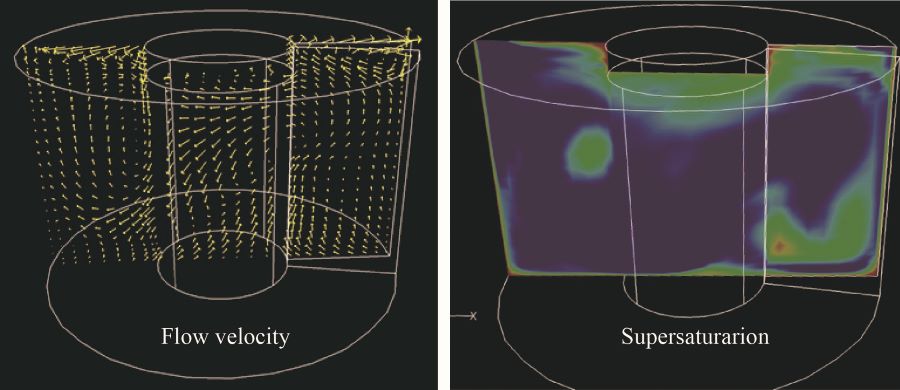
Simulation of heat and fluid flow of crystal growth
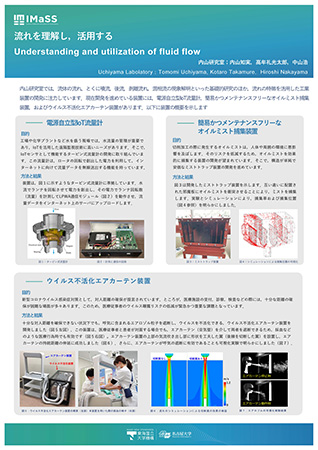
We are working on computational fluid dynamics(CFD) to analyze fluid phenomena by computer simulation. In particular, we focus on the CFD of multiphase flow in which gas, liquid, and solid phases coexist and flow while interacting with each other. Multiphase flow is intimately related to crystal growth. In addition to the simulation method used to analyze the convection, diffusion, and mixing of several kinds of liquid at an interface, we carry out simulation of the interaction between liquid and solid particles and among liquids, bubbles, and particles. We are also involved in experimental research on the development of a method of controlling the movement of disperse phases such as particles and bubbles using vortices in a liquid.
Member
-
Project
Development of Advanced Simulation Method for Flow Problems and Utilization of Natural Flow Energy
-
Project
Development of Multiscale Thermal Fluid Simulation Methods for Industry and Comprehensive Advancement of Simulation Technologies
-

Visiting Professor
NAKAYAMA, Hiroshi
-
Visiting Associate Professor
TAKAMURE, Kotaro



Porous Materials Chemistry
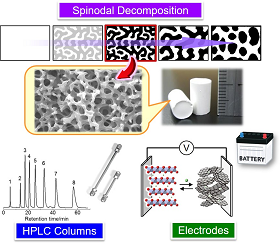
Preparation of porous monoliths by the phase separation method and their applications to HPLC columns
and battery electrodes.
Based on the liquid-phase synthesis utilizing polymerization-induced phase separation, we are developing various porous materials ranging from ceramics, organic polymers to organic-inorganic hybrids. The materials with a controlled porous structure are applied to separation media, adsorbents, catalyst supports and battery electrodes. We aim at revealing the influence of pore property on each functionality by interdisciplinary researches with analytical chemistry, organosynthesis and electrochemistry in order to contribute to the development in energy and environmental fields.
Member
-
Project
Structural Control of Porous Materials via Liquid-Phase Processes and their Applications
-
Visiting Professor
SUGAHARA, Yoshiyuki

Hard & Flexible Materials
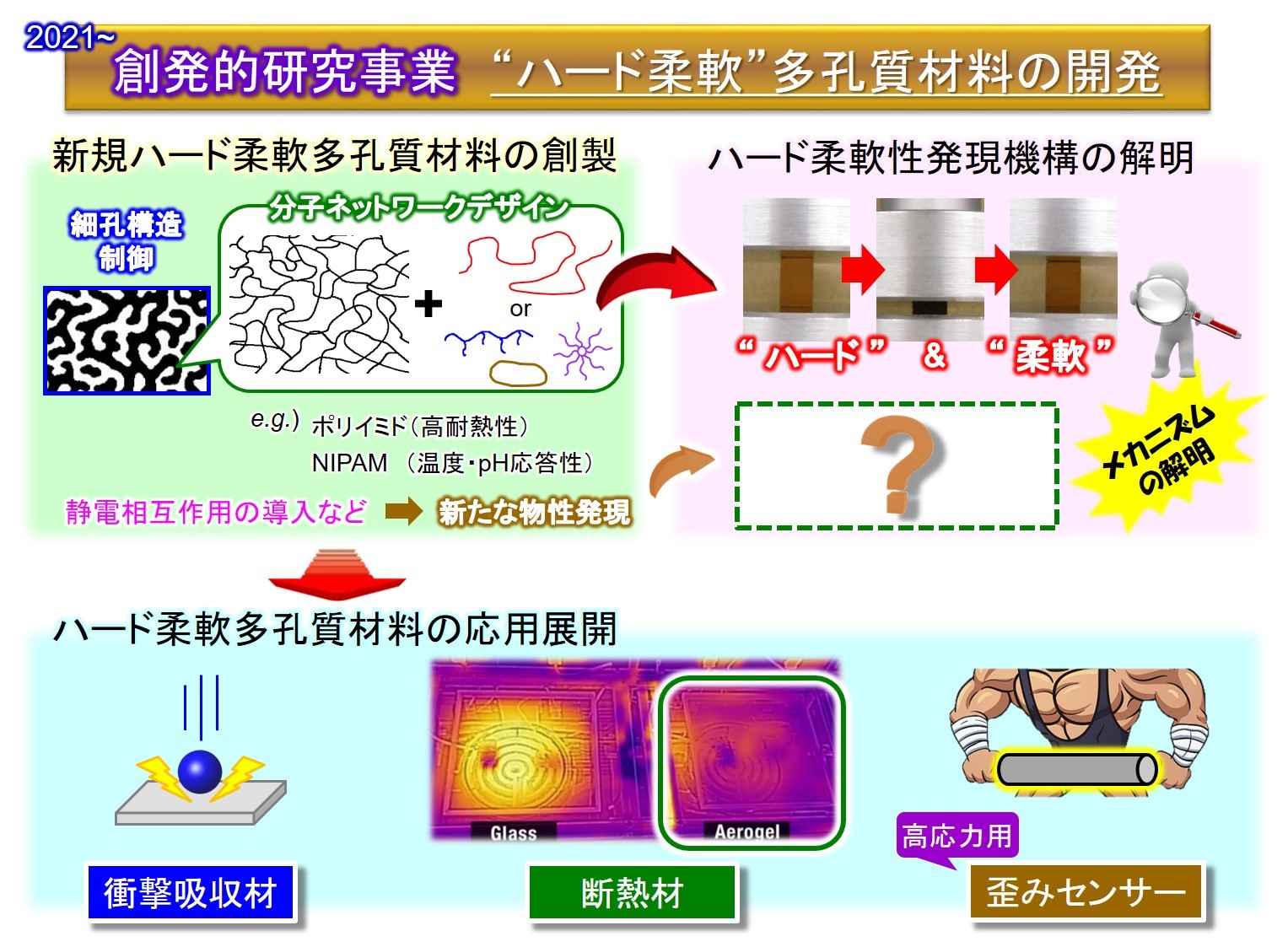
Development and Their Applications of Hard & Flexible Materials.
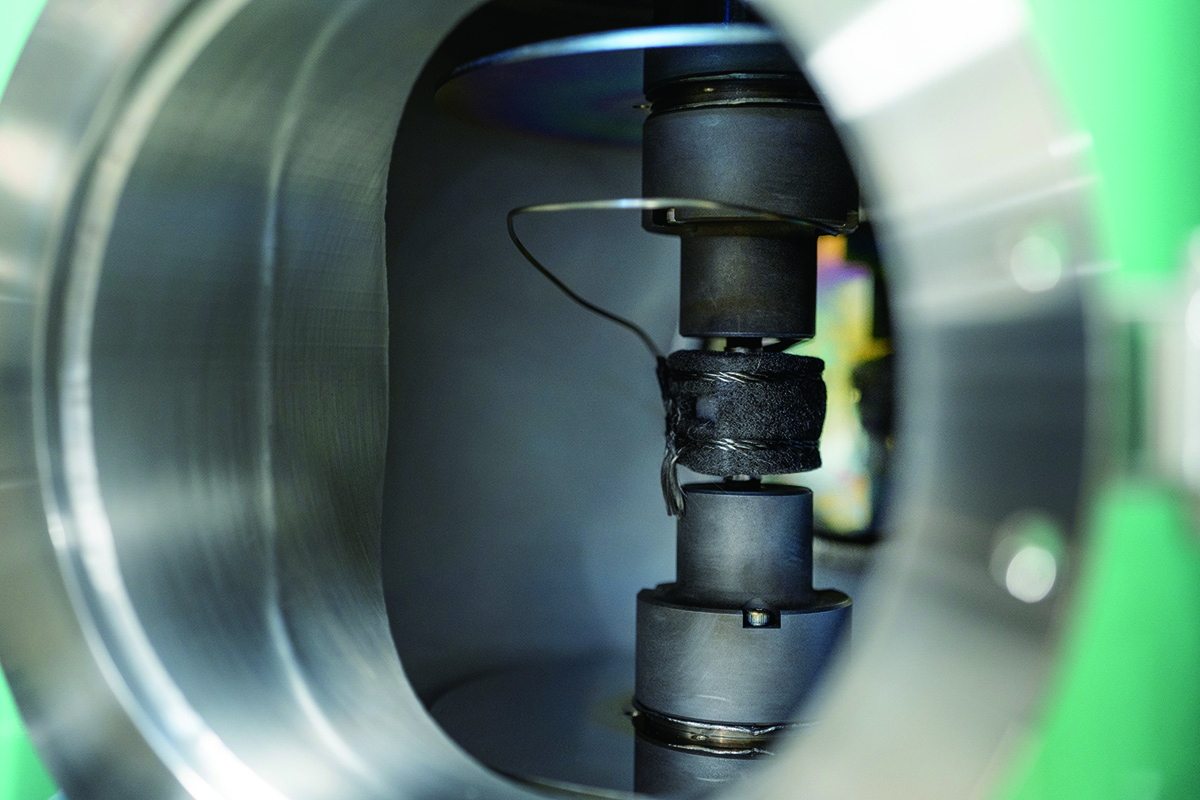
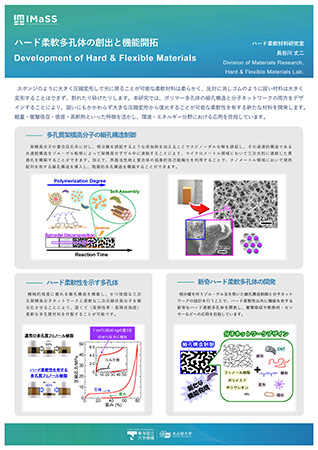
In general, flexible materials bearing high recoverability from a large deformation are soft, while hard materials with high elastic modulus show poor flexibility. We aim at developing novel porous materials with both high flexibility and high stiffness by designing macromolecular structures as well as porous morphologies.
Member
-
Project
Development of Hard & Flexible Materials by designing macromolecular structures and porous morphologies

Nanostructure Analysis and Design
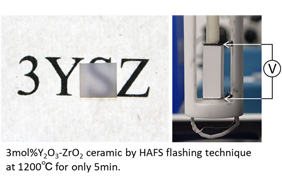
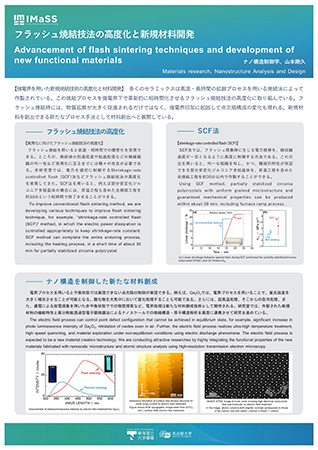
Functional properties of various ceramic materials are often related to the atomic structures and electronic states in the lattice mismatch regions such as the surfaces, grain boundaries, and interfaces. We are attempting to develop new functional ceramic materials including new ceramic processing techniques from the viewpoint of controlling the lattice mismatch region using the nanoscale analysis technique of high-resolution transmission electron microscopy.
Member
-
Project
Development of Ceramic Materials by Controlling the Atomic/Electronic Structures at Nano Scale

Theoretical Chemistry
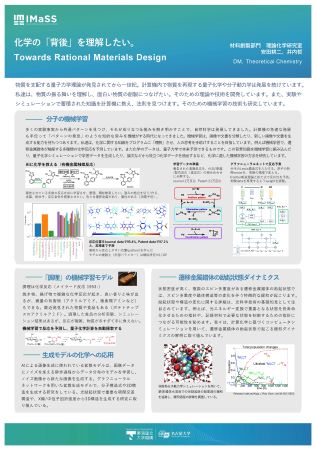
My group is involved in the development of machine learning algorithms for chemical data, the automatic design of molecules using structure‒property relationships, study on excited state dynamics, parallel algorithms and programs for material simulations on massively parallel computers, and new quantum-chemical theory for molecules and solids ( neural networks, graph theory, graphics processing units, CUDA, density matrices, Green’s function).
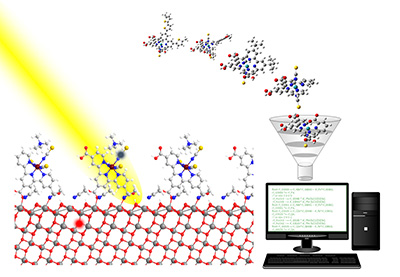
Ab initio study of the photoabsorption and charge separation process on the dye-sensitized semiconductor surface. A neural net learns the predicted structure-property relations and suggests better dyes.
Member
-
Project
Quantum Chemistry and Chemoinformatics, Methodology Development and Material Design

Materials Design Section
This Section promotes researches of material design with a focus on the microstructures of materials used in environments, electronics, mechanics and energy-related fields. Toward the aim of improving the performance and making major strides in terms of enhancements, the MD performs advanced studies through new compositions, novel composites and nanomaterials from the perspective of two- and three-dimensional and/or nanometer-scaled structures.
-
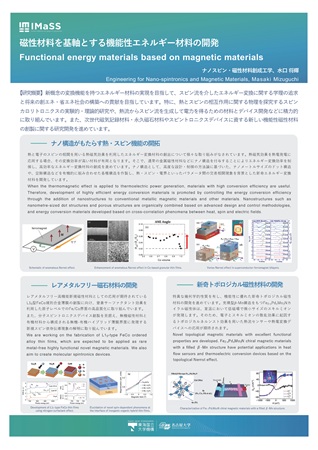
Engineering for Nano-spintronics and Magnetic Materials (Mizuguchi Lab.)
-
Energy Function Design Engineering (Nakamura Lab.)
-
Engineering for Nano-spintronics and Magnetic Materials
Our goal is to pursue the energy conversion via spin currents and to contribute to the construction of an energy-creating and energy-saving society in the future. In particular, we are working on experimental and theoretical studies of spin caloritronics, which explores the physics of the interaction between heat and spin, and on the development of materials and devices for generating spin currents from heat currents to generate electric power. Moreover, we are conducting research and development on the creation of new functional magnetic materials that will contribute to next-generation magnetic recording materials, permanent magnet materials, and spintronic devices.
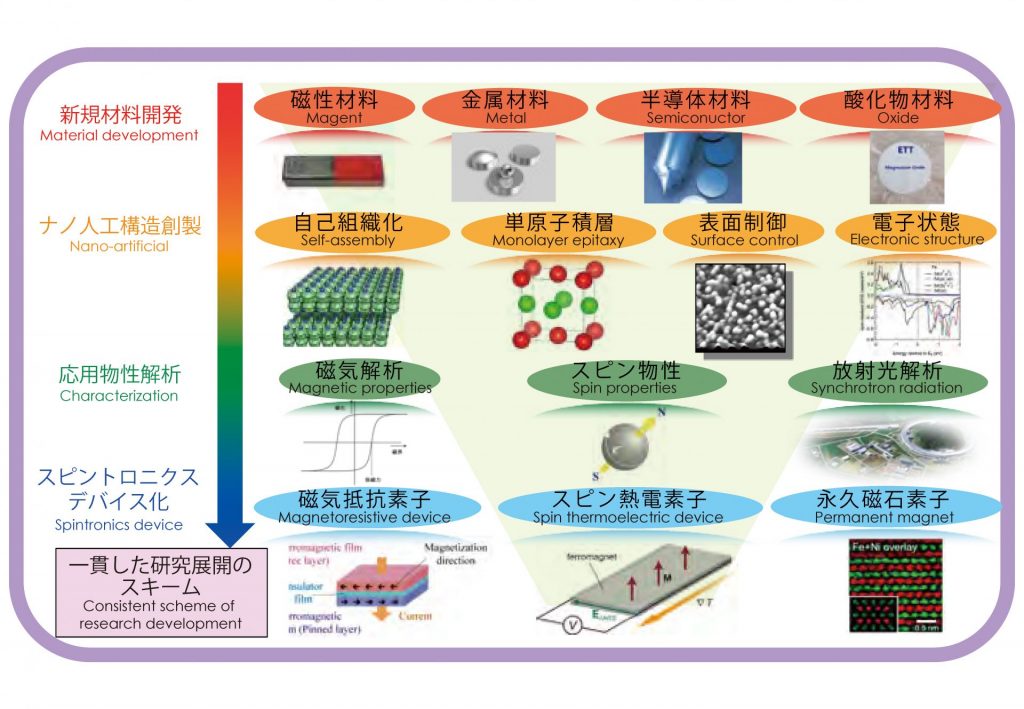
Research concept of the Engineering for Nano-spintronics and Magnetic Materials Group
Member
-
Project
Development of functional energy materials based on magnetic materials
-
Project
Atomic scale surface and interface characterizations of functional magnetic materials
-
Visiting Professor
KOMORI, Fumio


Energy Function Design Engineering
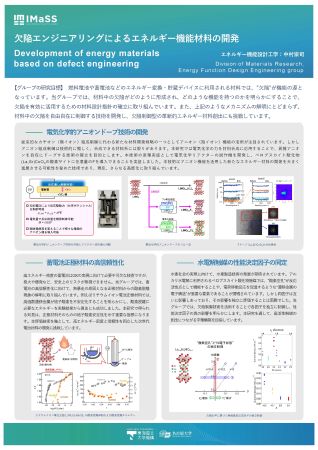
Defect species are recognized as a source of functionalities in energy materials such as catalysts and battery materials. However, the material development based on defect engineering is not yet established so far due to its difficulties. We aim to explore innovative energy functional materials by rational design and precise manipulation of defect structures.
Member
-
Project
Development of energy functional materials based on defect engineering
-

Project
Creation of photoionics and development of photoelectrochemical energy storage devices

Investigating ferroic-ordering and their device application
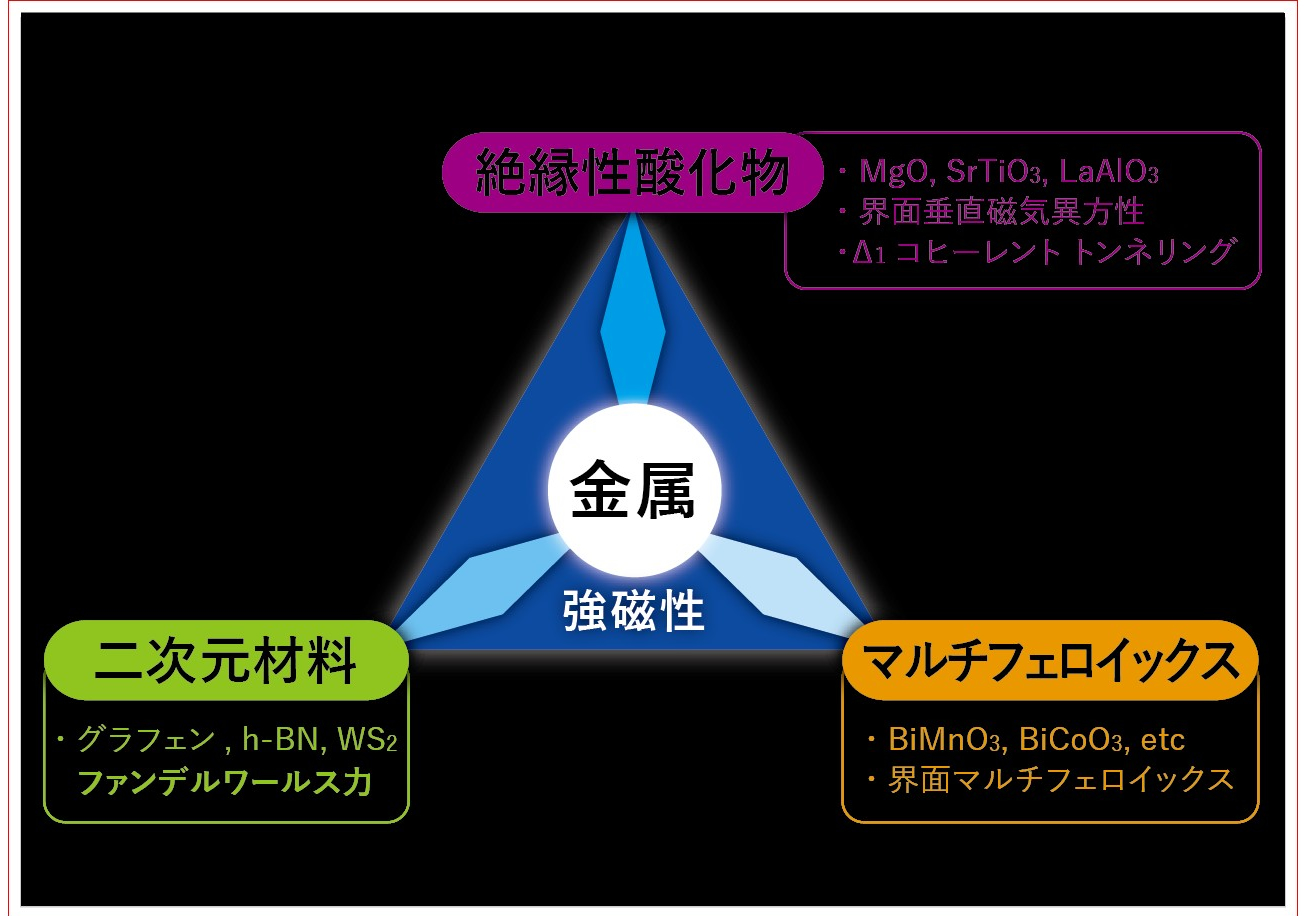
Exploring new ferroic-ordering materials (e.g. ferromagnetism, ferroelectricity, etc.) that appear at films or interfaces by using highly controlled growth technology and nano-fabrication of state-of-the-art, and further developing electronic devices.
Member
-
Project
High-performance functional materials and their device application

Materials Processing Section
In addition to research related to material production processes, the Materials Processing Section performs research on mechanical energy conversion devices that make use of high-performance thermal-insulation and -shielding materials, thermoelectric power-generating and dielectric elastomers, and other such materials, as well as research on, for example, high-efficiency hydrogen production, combustion, and power-generation processes.
-
Functional Nanomaterials (Osada Lab.)
-
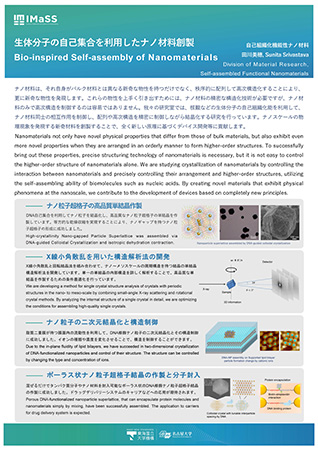
Self-assembled Functional Nanomaterials (Tagawa Lab.)
-
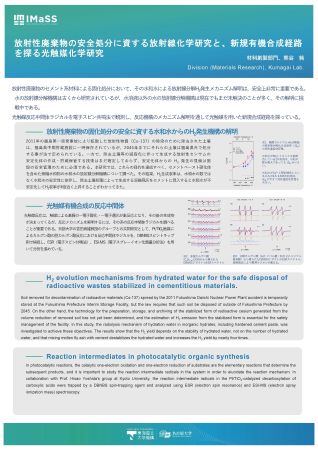
Radiation Chemistry & Biology (Satsuma/Kumagai Lab.)
Functional Nanomaterials
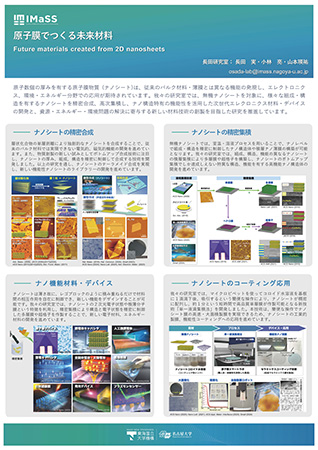
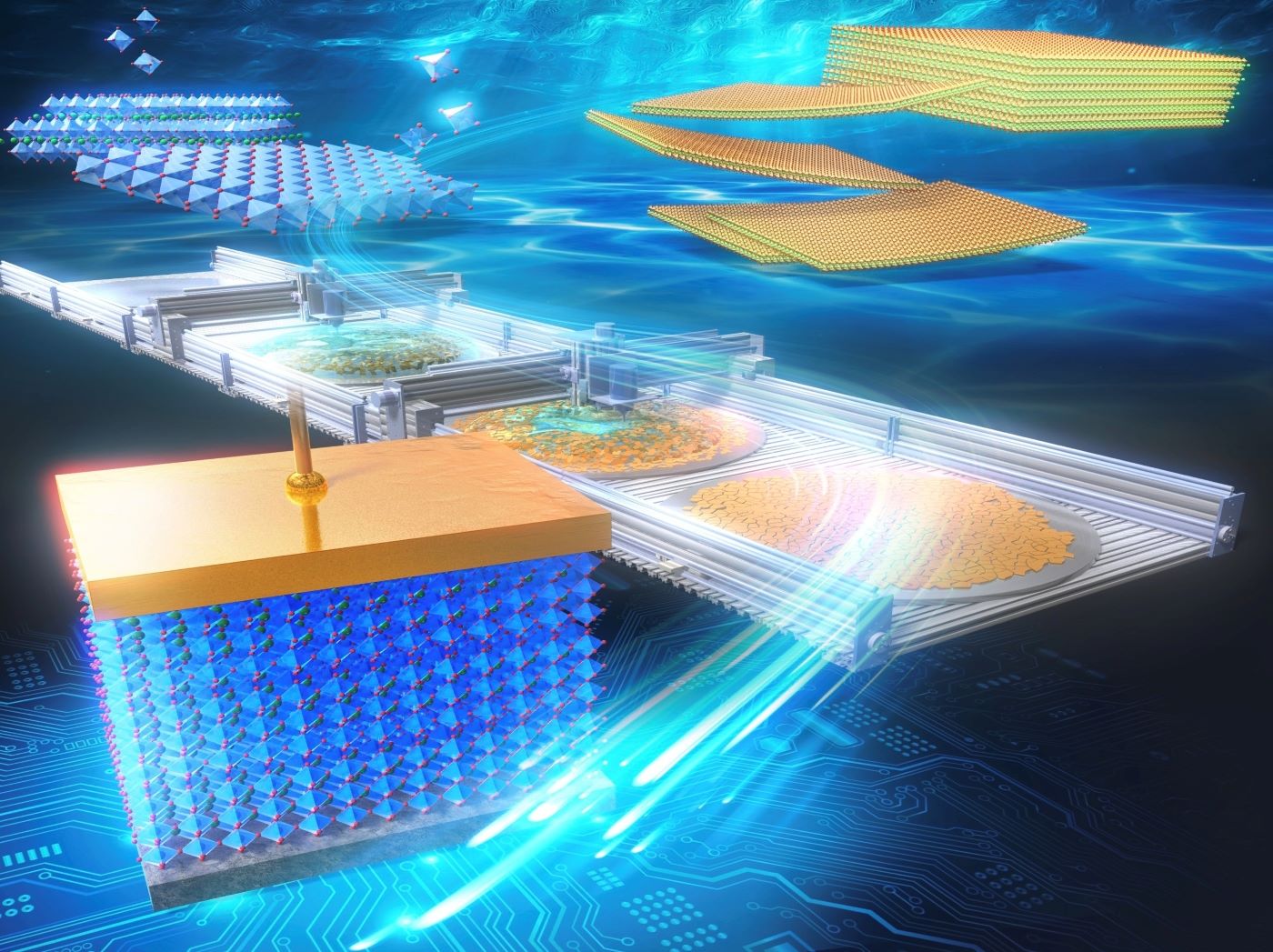
Nanomaterials with controlled size, morphology, and dimensions have been emerging as important new materials owing to their unique properties. In particular, two-dimensional(2D) nanosheets, which possess atomic or molecular thickness, have opened up new possibilities in exploring fascinating properties and novel devices. The Materials Processing Section is working on the creation of inorganic 2D nanosheets and the exploration of their novel functionalities in electronic and energy applications.
-
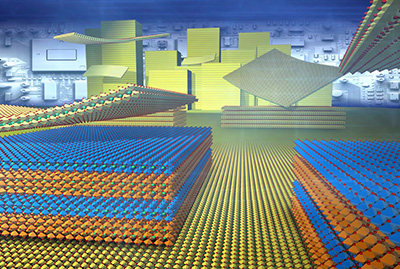
Controlled assembly of 2D nanosheets and its application to electronic devices.
-
Member
-
Project
Development of environmentally friendly electronics using two-dimensional materials
-
Project
Development of nanosheets and layered compounds with controlled electronic structures
-
Project
Bottom-up preparation of non-layer strucutred metal oxide nanosheet
-
Researcher
LI Yan
-
Visiting Professor
AKEDO, Jun
-
Visiting Professor
OGAWA, Makoto
-
Visiting Professor
OZAWA,Masakuni
-
Visiting Professor
MIMURA, Ken-ichi
-
Visiting Researcher
VITORIA, Rubén Cantón



Self-assembled Functional Nanomaterials
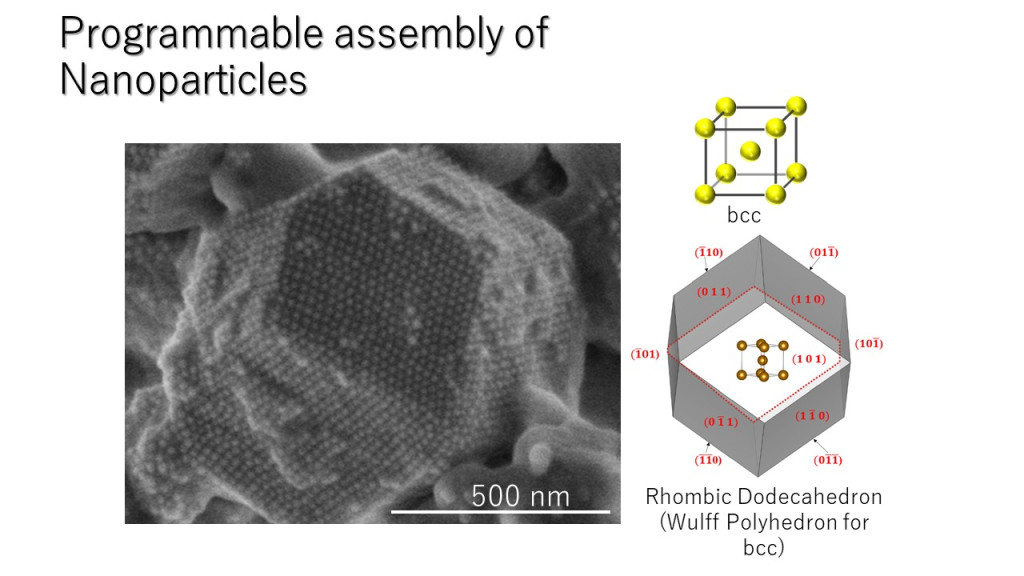
Nanoparticles and other nanosized materials (nanomaterials) not only have novel physical properties that differ from those of bulk materials, but also exhibit even more novel properties when they are arranged in an orderly manner to form higher-order structures. To successfully bring out these properties, precise structuring technology of nanomaterials is necessary, but it is not easy to control the higher-order structure of nanomaterials alone.
In the Self-Assembled Functional Nanomaterials Division, we are studying crystallization of nanomaterials by controlling the interaction between nanomaterials and precisely controlling their arrangement and higher-order structures, utilizing the self-assembling ability of biomolecules such as nucleic acids. By creating novel materials that exhibit physical phenomena at the nanoscale, we contribute to the development of devices based on completely new principles.
Member
-

Project
The Creation of Bio-inspired Novel Functionalized Nanomaterials
-

Assistant Professor
LI Xu
-

Visiting Associate Professor
SRIVASTAVA Sunita
-

Researcher
KUMAR Chandan
Radiation Chemistry & Biology
Member
-

Project
Development of Environmental-friendly Process by Nano-metal Particle Catalysts
-

Project
Chemical Reactions and Biological Effects Induced by Photo- and Ionizing Radiation as Studied by Detection of Radicals
-

Visiting Professor
HARADA, Katsuyoshi
-
Visiting Faculty
TSUDA, Taishi
